


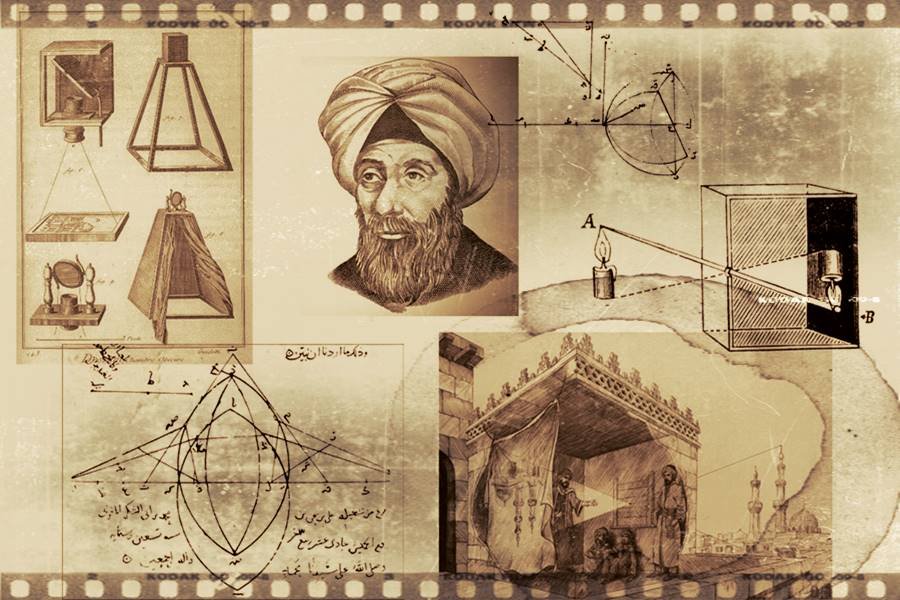
The Caliph’s Gamble and the Cost of a Wrong Calculation
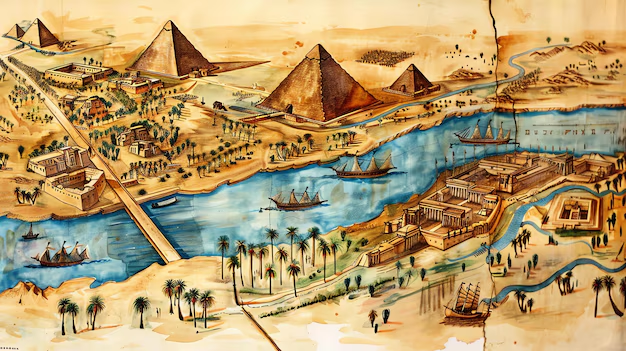
Cairo, 1011. Ibn al-Haytham stood before Caliph al-Hakim. He had promised to regulate the Nile’s floodwaters through a system of dams. The engineering failed. To al-Hakim, a ruler prone to erratic violence, this was an intolerable error.
He was placed under house arrest. This confinement shifted his focus from hydrology to optics. In his seminal work, Kitāb al-Manāẓir (Book of Optics), he dismantled the “emission theory.” This was the Greek belief that the eye sends out rays to “touch” objects. He didn’t experience a sudden “eureka” moment with the camera obscura; instead, he used it to prove intromission theory.
To validate that light travels in straight lines, he designed a rigorous protocol. He placed a light source and an opaque screen with a small aperture in a darkened room. He observed that the projected image remained inverted regardless of the object’s shape. By isolating variables and repeating the experiment, he replaced philosophical speculation with empirical evidence. He proved that light is an external physical entity, not a product of the eye.
The question was: if the senses could be deceived, what else was wrong?
The Dark Room: How Forced Silence Birthed the Camera Obscura
The walls of the Cairo residence were thick, but the light was relentless. Ibn al-Haytham spent years feigning madness to avoid the Caliph al-Hakim’s executioner, confined to a room with a single, small aperture in the wall. He observed that light passing through this hole projected an inverted image of the outside world onto the opposite wall—not as a vague reflection, but as a precise geometric projection.
This was the birth of the camera obscura. For centuries, thinkers like Euclid and Ptolemy championed “emission theory,” arguing the eye emitted rays to “touch” objects. In his Kitāb al-Manāẓir (Book of Optics), written between 1011 and 1021, al-Haytham dismantled this. He proved “intromission theory”: light is the active agent, and the eye is the passive receiver.
He spent a decade measuring the angles of incidence and the behavior of shadows to verify that light travels in straight lines.
He demonstrated that vision is a physical process of reflection and refraction, proving that light from a source strikes an object and then enters the eye.
By 1021, his cell had become a laboratory. He replaced the blind trust in ancient texts with a rigorous experimental method, using data to map the physics of light.
Shattering the Emission Theory: Why the Greeks Were Wrong About Sight
For centuries, the intellectual world followed the “emission theory.” In Optics, Euclid proposed that the eye emitted visual rays that physically touched objects to perceive them. Ptolemy expanded this, arguing that these rays acted as geometric probes to map the environment. To them, sight was an active projection the eye was the source, not the receiver.
Around 1021 CE, Ibn al-Haytham dismantled this narrative in his seminal work, Kitāb al-Manāẓir (Book of Optics). He didn’t just disagree; he used logic to expose a fatal flaw: if the eye emitted rays, the immediate pain caused by staring at the sun would be inexplicable. Why would a source of light be damaged by its own projection?
He proved the opposite using a camera obscura. By isolating a room and allowing light through a pinhole, he observed a perfectly inverted image on the opposite wall. This was the “smoking gun.” If sight were a projection from the eye, the image would not flip; it only inverts because light rays from the top of an object travel in straight lines into the hole and land at the bottom.
He shifted the burden of proof from ancient authority to the physical evidence of the inverted image.
The Geometry of Light: Mapping the Invisible Path from Object to Eye
In 1021, Ibn al-Haytham authored Kitāb al-Manāẓir (Book of Optics) while under house arrest in Cairo. He systematically dismantled the “emission theory” held by Euclid and Ptolemy. The prevailing Greek consensus viewed the eye as an active probe emitting rays. Ibn al-Haytham countered this with a rigorous logical progression. If the eye projected light, the immediate physical trauma caused by staring at the sun would be impossible. He argued that the eye is a passive receiver. The pain results from external light overwhelming the organ, not a failure of an internal beam.
By treating light as a physical entity a stream of particles moving in linear trajectories he shifted the geometry of sight. In his camera obscura experiments, he didn’t just observe an inverted image. He applied the law of rectilinear propagation. He proved that light rays from a single point on an object travel in straight lines through a pinhole. These rays intersect at a point on the opposite wall. This mathematical mapping transformed vision from a mystical “touch” into a geometric calculation of angles and intersections.
“The eye does not send out rays, but rather, light rays from the object enter the eye.”
[INTERNAL LINK: Ibn al-Haytham’s influence on the Scientific Method]
Skepticism as a Tool: The First Rejection of Ancient Authority
By the early 11th century, the Emission Theory of vision remained the undisputed standard. Euclid and Ptolemy championed this theory. It posited that the eye emitted “visual rays” to touch objects. In Cairo, Ibn al-Haytham found this logically flawed. He realized that if the eye projected light, those rays would take time to reach a distant star. Yet, we perceive the star instantly.
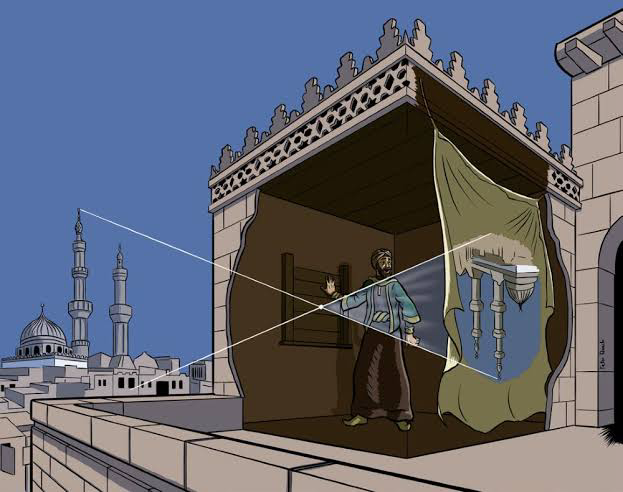
He spent years under house arrest. He feigned madness to survive the erratic temperament of Caliph al-Hakim. In the oppressive silence of his confinement, he observed a beam of light piercing a shuttered window. This projected an inverted image onto the wall. This was the camera obscura.
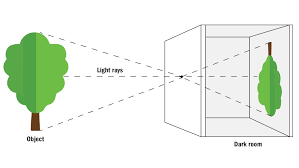
In his seminal work, Kitāb al-Manāẓir (Book of Optics), written around 1021, he dismantled the Aristotelian method of purely deductive reasoning. The Greeks relied on philosophical syllogisms. Ibn al-Haytham demanded experimental verification. He used darkened rooms and precise apertures. These proved light travels in straight lines and enters the eye from the outside. He didn’t just correct a theory; he replaced philosophy with a protocol of measurement.
He shifted the pursuit of truth from the study of ancient texts to the observation of the natural world.
A Manual for Truth: The Rigor of the Kitab al-Manazir
Ibn al-Haytham composed seven volumes of the Kitab al-Manazir while under house arrest in Cairo. He constructed a camera obscura. He used it to dismantle the “emission theory” championed by Ptolemy and Euclid. This theory claimed the eye projected “visual rays” to touch objects. He projected an inverted image of the outside world through a pinhole onto a wall. He demonstrated that light rays from multiple sources converged at a single point. This proved light entered the eye from the outside. This rendered the “projector” theory physically impossible.
He isolated variables using polished mirrors and lenses. He often worked in absolute darkness to eliminate ambient light contamination. This protocol was documented in his meticulous descriptions of “darkened chambers.” This shifted the burden of proof from philosophical authority to empirical evidence.
The Kitab al-Manazir reached Europe as De Aspectibus in the 12th century. It fundamentally reshaped Western optics. It directly influenced Roger Bacon’s Opus Majus (1267) and the later works of Johannes Kepler. Kepler used al-Haytham’s geometry to solve the mystery of the retina. Ibn al-Haytham treated the writings of the ancients as mere hypotheses. These were to be tested. He replaced the guesswork of the Greeks. He used a repeatable, skeptical blueprint for the scientific method.
The Silent Bridge: How Cairo’s Insights Rebuilt the Latin West
In 1021, the Kitab al-Manazir (Book of Optics) left Cairo’s libraries. It eventually reached the translation hubs of Toledo, Spain. For centuries, Western thought clung to the “emission theory.” This was the Greek belief that the eye projected rays to “touch” objects. Ibn al-Haytham dismantled this. He proved light enters the eye, but his real victory was the methodology.
He replaced the Greek reliance on abstract intuition with controlled, replicable experimentation. Ptolemy relied on geometry to describe what happened. Alhazen used a camera obscura a darkened room with a single pinhole to prove how it happened. He observed light rays crossing at a single point to project an inverted image. This proved that light travels in straight lines, regardless of the observer’s intent.
He shifted the pursuit of truth from the realm of philosophical debate to the realm of empirical evidence.
By the 12th century, the Latin translation De Aspectibus reached the universities of Italy. Roger Bacon cited these principles in his Opus Majus to argue for experimental science. Johannes Kepler later credited the same geometric laws to solve the mystery of the retina. A man who spent years in a Cairo cell provided the blueprint for the Scientific Revolution.
The Great Omission: Why the Scientific Revolution is Dated Wrong
The Great Omission: Why the Scientific Revolution is Dated Wrong
Science students usually remember 1687. Isaac Newton published Principia that year, which started the Enlightenment. But the scientific method the requirement that a theory be proven by a repeatable experiment worked six centuries earlier.
Textbooks often jump from the Greeks to the Renaissance, treating the time between as a gap. They ignore that Ibn al-Haytham dismantled the “emission theory” of vision in Cairo by 1021. He built a dark room, a camera obscura, to prove light travels in straight lines. He didn’t just theorize; he spent years in a state of self-imposed house arrest, meticulously measuring the angle of light through a pinhole in a wall to prove that the eye is a receiver, not a projector.
The foundation of modern physics wasn’t laid in a London study, but in the isolation of a Fatimid prison.
By the time Europeans used these principles, Ibn al-Haytham’s work had been translated into Latin as De Aspectibus. The credit shifted and the timeline changed. Schools teach that reason was reborn in the 17th century, but it had stayed active in a different region.
If the Foundation of Logic was Laid in a Cell, Who Still Owns the Truth?
The breakthrough didn’t happen in a royal court. It occurred under house arrest in Cairo. Around 1011, Caliph al-Hakim bi-Amr Allah confined Ibn al-Haytham to a secluded residence. This happened after the scholar failed to tame the Nile’s floods. In this isolation, he authored Kitāb al-Manāẓir (Book of Optics). This work dismantled two millennia of Greek thought.
Ptolemy and Euclid argued that the eye emits “visual rays” to perceive objects. This emission theory dominated since antiquity. Ibn al-Haytham used geometric proofs to prove the opposite. He observed a single beam of sunlight filtering through a pinhole in his shuttered room. This created an inverted image on the wall. This “camera obscura” effect provided empirical evidence. It showed that light travels in straight lines and enters the eye from the outside.
By replacing philosophical speculation with repeatable experimentation, he shifted the burden of proof. He moved it from the scholar’s reputation to the evidence itself. Attributing the Scientific Revolution solely to 17th-century Europe ignores this blueprint. The tools we use to define “fact” were refined in a Cairo cell. This proves that intellectual liberation often begins when the world tries to silence the thinker.
Frequently Asked Questions
Q: Who was Ibn al-Haytham and why is he famous?
A: Ibn al-Haytham was a pioneering physicist and mathematician from the Golden Age of Islam who is widely regarded as the “father of modern optics.” He fundamentally changed how we understand vision by proving that light reflects off objects and enters the eye, rather than the eye emitting rays. His monumental work, the Book of Optics, laid the groundwork for the scientific method by insisting that hypotheses be proven through repeatable experiments and mathematical evidence.
Q: Why does the work of Ibn al-Haytham matter today?
A: The contributions of Ibn al-Haytham matter because he formalized the experimental method that defines all modern science. Before him, “science” was often based on philosophical deduction; he shifted the focus to empirical evidence and rigorous testing. Every time a scientist conducts a controlled experiment or a physicist studies the behavior of light, they are utilizing a framework that Ibn al-Haytham helped build over a thousand years ago in Cairo.
Q: Is it true that Ibn al-Haytham discovered the camera obscura?
A: While Ibn al-Haytham did not “invent” the camera obscura, he was the first to provide a scientific explanation for how it works. Many people mistakenly believe the device was a later European discovery, but Ibn al-Haytham used the dark room and pinhole effect to prove that light travels in straight lines. By documenting this phenomenon, he bridged the gap between abstract geometry and the physical reality of how images are formed.
Q: In what historical context did Ibn al-Haytham conduct his research?
A: Ibn al-Haytham lived and worked during the Islamic Golden Age, a period where scholars in the Middle East synthesized Greek, Indian, and Persian knowledge. Based largely in Cairo under the Fatimid Caliphate, he operated in an intellectual environment that prioritized the pursuit of knowledge and translation. This era of openness allowed him to critique the established theories of Ptolemy and Euclid, turning the curiosity of the ancient world into a structured scientific discipline.
Q: What is a surprising fact about Ibn al-Haytham’s life?
A: A surprising fact about Ibn al-Haytham is that some of his most groundbreaking discoveries were made while he was under house arrest. After claiming he could regulate the flooding of the Nile—and then realizing the engineering was impossible for the time—the Caliph al-Hakim placed him under confinement. Rather than despairing, he used this forced isolation to conduct the meticulous experiments on light and shadow that would eventually revolutionize the world of physics.

